Introduction to Thermal Metrology
Dr. Patrick Hopkins
What You Need to Know
Measurements of thermal transport properties of materials, such as thermal conductivity and thermal diffusivity, rely on being able to measure the temperature changes along a thermal gradient induced by an applied heat flux. Thermal transport metrologies typically rely on the following procedure: first, apply a heat flux (Q) to a material to induce a temperature gradient. Second, measure the change in temperature (ΔT) at one or several points in space and time along this gradient. Third, relate the measured ΔT as a function of Q to the heat equation to extract thermal conductivity and thermal diffusivity.
The right method for this depends heavily on the material and geometry in question. A thin film only tens of nanometers thick, a bulk ceramic, and a soft polymer each present different measurement problems, and the history of thermal metrology is in large part a history of techniques developed to address one of these cases at a time.
Contact-Based Techniques and Their Limits
Traditional thermal conductivity measurement techniques apply heat sources or sensors (thermometers) via direct contact with a material. Guarded hot plate, for example, places a heater in contact with the measurement specimen to apply a known heat flux, then measures the temperature at various locations along the induced gradient to provide ΔT as a function of Q.
These techniques work well for materials with enough bulk volume to accommodate heaters and sensors that are often orders of magnitude larger than the feature of interest. This becomes a problem for coatings and thin films, which are common in modern micro- and nanotechnologies. When the heater and sensor are much larger than the film itself, the measured temperatures and temperature gradients are dominated by everything surrounding the film rather than the film. As a result, these techniques are not well suited to accurately measuring the thermal conductivity of thin film materials.
Advances in lithography extended contact-based measurement to smaller scales. Metal lines patterned onto a sample can be Joule heated to provide a known heat flux, and changes in their electrical resistance can be used to measure ΔT. These electrical resistance thermometry methods require the ability to precisely pattern metal heaters and sensors at well-defined locations, since the accuracy of the resulting thermal conductivity measurement depends directly on how well the applied heat flux and the resulting ΔT are known.
Bulk and soft materials introduce a different set of complications. Many are too compliant, too thermally insulating, or too irregular in geometry for contact-based heaters and sensors to interface with reliably. Poor or inconsistent thermal contact between a sensor and a soft or uneven surface can introduce error that is difficult to characterize or correct for.
Laser-Based Methods: Laser Flash and Thermoreflectance
Non-contact, laser-based opto-thermal techniques apply a known heat flux and measure temperature changes without patterning metal lines or relying on advanced lithography. Because the heating is laser-based, the heater geometry can be controlled simply by adjusting the laser spot size, delivering a well-known Q to the sample surface. The resulting temperature change can then be measured using pyrometers, common in Laser Flash, or reflected lasers, used in thermoreflectance measurements.
Traditional Laser Flash applies a pulsed laser to rapidly heat one side of a sample while measuring the transient temperature change on the opposite side. Because the measurement is dominated by whichever part of the material has the largest thermal resistance through the sample thickness, this approach is generally not applicable to thin films, which are much thinner than the total sample thickness.
Thermoreflectance-based metrologies, including time-domain, frequency-domain, and steady-state thermoreflectance (TDTR, FDTR, and SSTR), address this limitation. Two differences separate these techniques from Laser Flash. First, thermoreflectance techniques are pump-probe techniques: one laser delivers the heat flux (pump) while a second laser’s reflectivity change is used to determine ΔT (probe). Second, the pump and probe can be delivered to the same side of the sample through focused laser sources. This significantly increases sensitivity to films and coatings that make up only a fraction of the total sample thickness, which is why thermoreflectance techniques have been widely used for decades to measure the thermal transport properties of coatings, thin films, atomically thin interfaces, and even 2D materials.
Steady State vs. Transient: Why It Matters
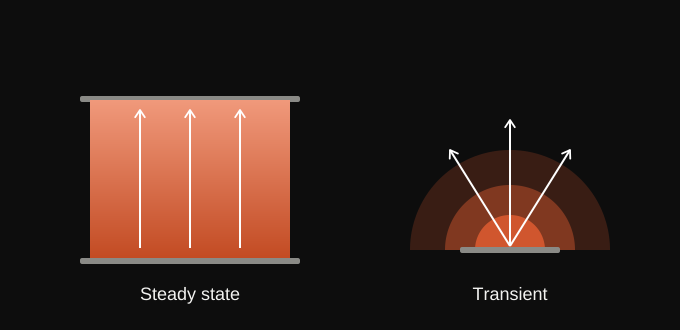
Thermal transport measurement techniques can be broadly grouped into two categories.
Steady state methods capture a measurement once the temperature gradient in a sample is constant in time. After heat is applied and a steady-state gradient is reached, that gradient is measured and directly related to thermal conductivity.
Transient methods take measurements as a function of time during or after a heating event, while the temperature at a point in the material is still changing. These measurements can use different transient heater and sensor designs, including hot wire, plane source, or transient laser-based methods such as Laser Flash.
Transient techniques, including Laser Flash, TDTR, and FDTR, relate the measured changing temperatures to the transient heat equation. This means the measured ΔT is tied to thermal diffusivity, or to a property that is a function of both thermal conductivity (k) and heat capacity (C). For these techniques, the heat capacity of the material must be known separately to extract k.
Steady-state techniques relate the measured ΔT to the steady-state heat equation, known as Fourier’s Law. In steady state, the temperature gradient has no dependency on the sample’s heat capacity. This makes steady-state thermometry, such as FASTR, a distinct class of thermal transport metrology: one capable of measuring thermal conductivity directly, without inferring it from a diffusivity measurement. This advantage extends to thin films, where thermal conductivity can be measured directly rather than derived indirectly.
Beyond Thin Films: Bulk Materials and Anisotropy
The steady-state advantage is not limited to thin films. The same underlying principle, measuring thermal conductivity directly from a steady-state gradient rather than inferring it from a transient decay, extends to bulk and soft materials as well, where contact-based methods often struggle for the reasons described earlier.
A separate challenge shows up in materials with anisotropic thermal transport, where thermal conductivity is not a single number but varies by direction. Many advanced materials, including certain high-k dielectrics and layered materials, conduct heat very differently in-plane than through-plane. Measuring both directions requires a technique with the sensitivity to distinguish them, which most conventional and even many laser-based methods are not built to do.
Laser Thermal’s TOPS platform was developed to address both of these cases. Its SST mode extends steady-state thermoreflectance measurement to bulk and soft materials. Its LIT mode adds the in-plane sensitivity needed to resolve anisotropic thermal conductivity in high-k and directionally dependent materials.
Where Measurement Is Headed
As devices and material stacks continue to scale down, the features that determine thermal performance are shrinking with them. Interfaces, boundaries, and nanoscale structures increasingly govern how heat moves through a system, often more than the surrounding bulk material. Measuring thermal transport at this scale introduces new challenges, since the assumptions that hold for bulk or thin film measurements do not always hold when the dominant thermal resistance is confined to a boundary just a few atomic layers thick.
This is an active area of development in thermal metrology, and one that will continue to shape how thermal characterization tools are designed in the years ahead.